Making Space for Stimming

Since April is Autism Awareness Month, I wanted to spend some time talking about some of the things people often see in autism but may not fully understand.

One of those things is stimming.

Stimming is short for self-stimulatory behavior, and it refers to repetitive movements or sounds that help someone regulate their body or emotions.

For autistic individuals, stimming is often a natural and important way to process the world around them.

It can happen when someone is excited, overwhelmed, happy, anxious, or simply trying to focus.

And while the word might sound clinical, stimming itself is actually very human.

Many people stim in some way without even realizing it.

Think about things like:

• tapping your foot

• twirling your hair

• clicking a pen

• bouncing your leg while sitting

These are all small ways people help their bodies stay regulated.

For autistic individuals, those behaviors may simply look a little different.

Stimming can look like:

• hand movements

• rocking or swaying

• bouncing

• repeating sounds

• snapping or clapping

• pacing

• flapping arms

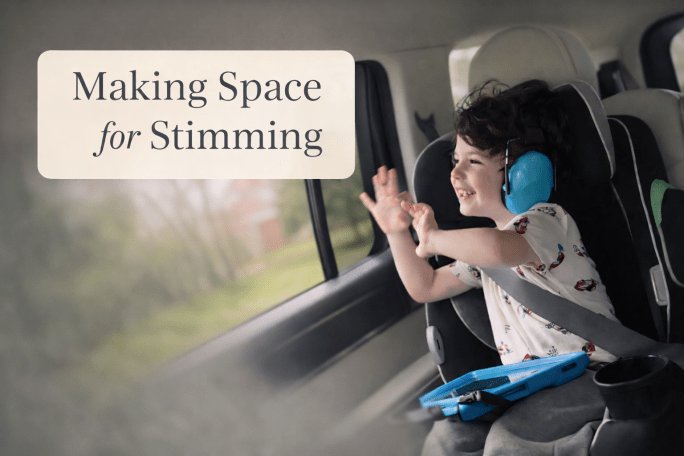
For August, stimming often looks like bouncing, swaying side to side, clapping, snapping his fingers, or flapping his arms when he’s excited.

Sometimes he makes little sounds while he moves, especially when he’s listening to music or feeling really happy.

Sometimes his stimming helps him regulate when he’s overwhelmed.

And sometimes it’s simply his way of experiencing joy.

Earlier in our journey, we didn’t fully understand stimming. Like many parents, our first instinct was to try to stop it.

But as we learned more about autism, our perspective shifted.

Now, instead of trying to stop stimming, we try to make space for it.

Because we’ve realized that for August, these movements help his body regulate and process the world around him.

And sometimes, they’re simply an expression of happiness.

Sometimes when people see stimming in public, they assume something is wrong.

But often, it’s simply a child expressing excitement or helping their body feel regulated.

Stimming is not something that automatically needs to be “fixed.”

In many cases, it’s an important tool that helps autistic individuals regulate their nervous system and feel more comfortable in their environment.

That doesn’t mean every stim is safe in every situation, but understanding why it happens is an important step toward compassion.

One of the things autism has taught our family is that behaviors often have meaning behind them.

When we take the time to understand those behaviors instead of immediately trying to stop them, we learn a lot more about what our children need.

Sometimes the best thing we can do is simply make space for someone to regulate in the way that works for them.

Stimming may look unfamiliar to some people, but it is often just a person’s way of helping their body feel calm, safe, and balanced.

And once you understand that, it starts to feel a lot less mysterious.
This Haircut Was a BIG Deal

This week, we had a win.

And I mean a big win.

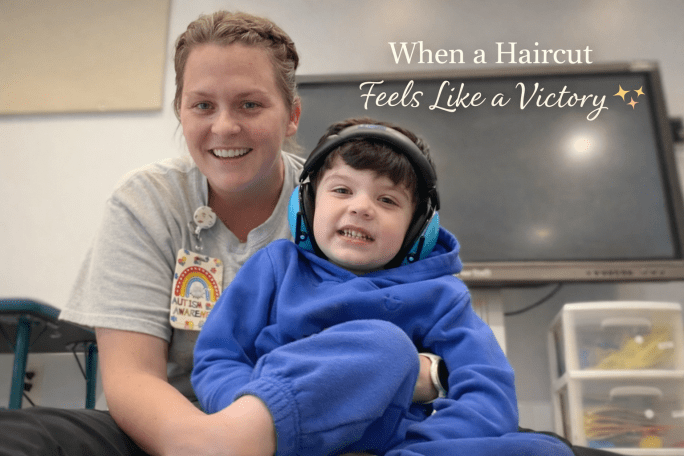
August let me cut his hair.

And if you know August, you already know this is kind of a big deal… because the boy has a ton of thick, wild hair. 😂 It’s basically his signature.

But haircuts in our house have never been simple.

In fact, we used to dread them.

We knew going into it that it would take what felt like an entire NFL defensive line just to hold him still long enough to get through it.

And even then, it was awful.

Snot.

Tears.

Hair everywhere.

And the hardest part wasn’t even the haircut itself.

It was what came after.

Haircuts would trigger huge meltdowns that could last for hours.

We learned very quickly to clear the calendar on haircut day, because we knew the rest of the day would be spent helping August regulate and recover.

This isn’t something most parents of neurotypical kids even have to think about.

But for sensory-sensitive children, something as simple as a haircut can be painfully overstimulating.

The sound of clippers.

Hair falling on the skin.

Someone touching your head and ears.

For August, all of that can feel like too much.

But this week, something different happened.

He sat in the chair while I cut his hair for about 15 minutes.

No tears.

No big meltdown.

Just a little fuss when I got close to his ears — which, honestly, is completely understandable. Even many adults don’t love that part.

And for us, that felt like a huge victory.

The Wins That People Don’t Always See

One thing parenting a child with autism has taught me is that progress often looks different than people expect.

Sometimes progress isn’t measured in big milestones.

Sometimes it looks like:

A haircut without tears.

Brushing teeth for a few extra seconds.

Trying something new without panic.

These are the moments that quietly tell you something is changing.

Growth is happening.

Confidence is building.

And even though they may seem small from the outside, they mean everything to us.

Learning to Celebrate the Small Things

When August was first diagnosed, I didn’t fully understand how important these little victories would become.

Now I do.

Because every time he tolerates something that once felt impossible, it’s a reminder of how far he has come.

It’s a reminder that progress isn’t always loud or dramatic.

Sometimes it’s quiet.

Sometimes it’s a 15-minute haircut.

And sometimes that’s more than enough to celebrate.

Progress Over Perfection

Parenting August has changed the way I look at growth.

I’ve learned to celebrate effort.

To notice the small steps forward.

To appreciate the moments when something that used to feel overwhelming suddenly becomes manageable.

And this week, a haircut felt like a really big step.

So yes — we’re celebrating it.

Because progress deserves to be noticed.

Even the quiet kind.

Navigating Meltdowns

Let’s just say it plainly.

Meltdowns are freakin’ hard.

Not the “wrong color cup” kind. I mean the full-body, nervous-system-overloaded kind.

For a long time, I thought meltdowns meant I was doing something wrong. That if I had prepared better or transitioned smoother or explained more clearly, we could avoid them.

Sometimes prevention helps.

Sometimes it absolutely does not.

And that was a hard lesson for me.

First: You Cannot Reason During a Meltdown

You cannot logic someone out of a nervous system that’s completely overwhelmed.

Trying to reason in the middle of it only makes things worse. It’s not the time for life lessons. It’s not the time for “use your words.” It’s definitely not the time for consequences.

When August is melting down, we don’t lecture.

We make sure he’s safe.

And then we give him space.

August needs space and a soft place to land — literally. We actually have a crash pad in our living room. Just fully committed at this point. If he needs to drop to his knees or crash forward, there’s somewhere safe for him to do it.

When he’s overwhelmed, his body needs release. So we clear the area, stay close enough to observe, and let him work it out.

Close enough to protect.

Far enough not to add more input.

Because nothing says “we’ve adjusted to autism parenting” quite like home decor that doubles as impact protection.

When It Was Really Hard

There was a season when his meltdowns were intense.

He would scratch his arms until they bled.

He would claw at his face.

He would pull at his hair.

It was heartbreaking to watch.

In those moments, space alone wasn’t enough. We had to step in physically to keep him safe. Sometimes that meant giving him a firm “bear hug” — not as punishment, but as protection. Just enough pressure to keep his body from hurting itself.

No one really prepares you for becoming a human weighted blanket, but here we are.

Those were exhausting days.

What Helps August

Over time, we learned that August benefits from proprioceptive input — basically, deep pressure that helps his body regulate.

So we adjusted.

We give him firm squeezes to his large muscle groups.

We press his hands between ours.

We use headphones when he needs pressure around his head.

At school, he sometimes benefits from a compression vest.

These aren’t magic fixes.

But they help.

And sometimes helping a little is enough to shorten the storm.

What I’ve Learned

Meltdowns are NOT manipulation.

They are overwhelm.

They are a tiny nervous system saying, “I cannot handle this right now.”

Our job isn’t to control it.

It’s to create safety within it.

Some days that looks calm and confident.

Some days that looks like me whispering, “Lord, please,” under my breath while barely holding it together in public.

But we’re learning.

We’re adjusting.

We’re finding what works for August.

If you’re walking through intense meltdowns right now — sitting on the floor while your child cries, or driving home in silence after a public one —

You’re not failing.

You’re learning your child’s language.

And that takes time.

August, always.