The Childhood We Didn’t Expect (But Learned to Love)

There are a lot of things people associate with autism.

Therapy appointments.

Evaluations.

Meltdowns.

Sensory needs.

And yes — those things are part of our life.

But so is laughter.

A lot of it.

When August was first diagnosed, I quietly grieved the picture of childhood I had always imagined. The one where everything looked typical and predictable.

But over time, something changed.

Instead of focusing on what we thought childhood would look like, we started paying attention to what actually makes August happy.

And it turns out, the little things are where the joy lives.

August loves music. When one of his favorite songs comes on, he lights up. He’ll bounce back and forth and sway side to side like the music is moving through him.

Sometimes he claps along to the rhythm. Other times he snaps his fingers and makes silly sounds while he dances.

It’s impossible not to smile when you see it.

He also loves light-up toys and anything that makes sound. One of his favorite things right now is the Bluey keytar he got for Christmas. If music starts playing in our house, there’s a very good chance August is nearby, happily pressing the keys and dancing along.

Another thing August loves is connection.

He gives the best hugs and is always ready with a high five. And if you try to tickle him, be prepared — he will absolutely dissolve into laughter.

But if you asked August what his favorite activity is, the answer would still be easy.

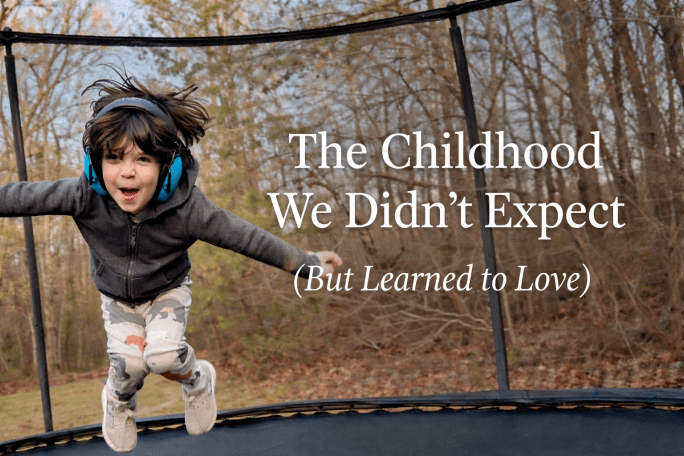
Jumping.

More specifically, jumping and crashing onto his crash pad.

He will jump, crash, bounce back up, and do it all over again with the biggest grin on his face.

And when summer comes around, the trampoline has some competition.

August loves water play. The sprinkler, the hose, splashing in puddles — if water is involved, he’s all in. Watching him run through the sprinkler and laugh is one of those simple childhood moments that never gets old.

One thing autism has taught us is to never take small milestones for granted.

Things that once felt ordinary suddenly feel worth celebrating. Progress is noticed more carefully. Little victories matter more.

And because of that, the joyful moments feel even bigger.

Not every part of an autism diagnosis is easy or fun. There are hard days. There are challenges we didn’t expect— and still don’t know how to handle.

But we’ve learned something important along the way:

We still get to have fun.

Sometimes it just looks different than we once imagined.

Sometimes fun looks like dancing in the living room.

Sometimes it looks like silly sounds and belly laughs.

Sometimes it looks like a boy jumping full force onto a crash pad over and over again.

And sometimes it looks like a mom sitting on the couch watching all of it unfold… while silently wondering how one small human has this much energy.

We don’t spend our time mourning what we once thought August’s childhood would look like.

Instead, we’ve learned to celebrate the childhood he’s actually living.

And in many ways, this journey has shaped us as parents in ways we didn’t expect.

It’s taught us to slow down.

To notice the little things.

To celebrate progress, no matter how small.

And that perspective is something we now carry into raising Sawyer too.

Whether his path includes a diagnosis or not, we want to approach his childhood the same way — with gratitude, patience, and a deep appreciation for the moments that make him who he is.

Because at the end of the day, joy doesn’t have to look typical to be real.

And August brings a lot of it into our home.

(Along with an impressive amount of trampoline bouncing and full speed crashing.)
This Is Our Testimony in Motion

I want to share something clearly — and from a place of deep peace.

As a family, we believe that God has already healed August.

Not “maybe someday.”

Not “if everything lines up perfectly.”

Not “if therapy works hard enough.”

We believe it is done.

And right now, we are walking patiently and faithfully as we wait for that healing to manifest physically.

That doesn’t mean the journey isn’t real.

We still sit in evaluations.

We still attend therapy.

We still navigate meltdowns.

We still have hard days.

We feel them.

But we walk through them anchored in something steady.

August’s diagnosis did not surprise God.

Autism is not stronger than the name of Jesus.

And this story is not over.

There are days when our faith feels bold and immovable.

There are days when it feels quiet and whispered.

Both count.

We are not pretending the road is easy.

We are choosing to trust the One who walks it with us.

We believe August will be fully restored to health.

We believe God is going to use him in a mighty, powerful way.

We believe his life will point people to the Lord.

We know not everyone will understand this kind of faith, and that’s okay — this is simply where the Lord has anchored our hearts.

And while we wait, we praise.

We praise God for:

• The progress we’ve already seen

• The growth that is happening

• The strength in our marriage

• The compassion growing in our family

• The faith that has deepened in the waiting

This blog is not just about autism parenting.

It is a record of what God is doing — in August, and in us.

Every therapy session.

Every breakthrough.

Every hard moment.

Every answered prayer.

This is our testimony unfolding in real time.

We don’t know the timeline.

We don’t know the method.

But we know the Healer.

And until the fullness of that healing is visible, we will keep showing up.

We will keep advocating.

We will keep praying.

We will keep praising.

To God be the glory — in the waiting, and in the restoration.

Guilt is Not a Parenting Strategy

I used to feel guilty all the time.

Guilty for not doing enough.

Guilty for resting.

Guilty for losing my temper during a stressful episode.

Guilty for needing quiet.

One of the many things this journey has taught me is to let it go.

Call me Elsa.

This season — early mornings, a baby who treats sleep like a suggestion, big emotions and even bigger responsibilities — has made something very clear:

Guilt and shame are not tools.

They don’t make me a better mom.

They don’t regulate my nervous system.

They just make everything heavier.

I’ve learned that conviction and guilt are not the same thing – and one comes from love, not shame.

What I’ve Stopped Feeling Guilty About

1. Asking for Help

Needing help doesn’t mean I’m incapable.

It means I’m raising children in a demanding season. It means I understand that sustainable motherhood isn’t meant to be done alone.

Also, if someone offers to hold the baby so I can shower in peace? I’m saying yes.

Strong moms build support systems.

2. Letting the House Be “Lived In”

My house is not a showroom.

It’s a therapy recovery zone.

A baby play space.

A snack distribution center.

Clean enough is enough.

If you come over and see toys on the floor, congratulations — children live here.

A regulated mom matters more than spotless counters.

3. Napping When the Baby Naps

Rest is not laziness.

Rest helps me show up with patience.

Rest keeps me from turning bedtime into a personality test.

Rest supports my health, my hormones, and even my long-term goals.

I don’t have to earn rest by completing a productivity checklist first.

Sometimes I earn it simply by waking up at 5:00.

4. Saying No

No to overloading our calendar.

No to things that disrupt our rhythm.

No to pretending I have unlimited capacity.

Structure helps.

But rigidity burns us out.

Flexibility > perfection.

If it costs us our peace, it’s too expensive.

5. Protecting Our Peace

Not every invitation is necessary.

Not every opinion deserves space.

Not every comparison deserves attention.

Especially not the ones coming from social media where everyone’s kitchen is spotless and their toddlers eat quinoa without complaint.

I am not competing with influencers who don’t live my life.

We keep it simple here.

Simple meals.

Simple routines.

Simple expectations.

Because simple is sustainable.

The Truth About Mom Guilt

Guilt and shame are not productivity strategies.

They don’t make me more patient.

They don’t make my kids more regulated.

They don’t make this season lighter.

Structure helps.

Flexibility helps.

Rest helps.

Simplicity helps.

But guilt?

I’m not using that anymore.

Grace is a much better teacher.