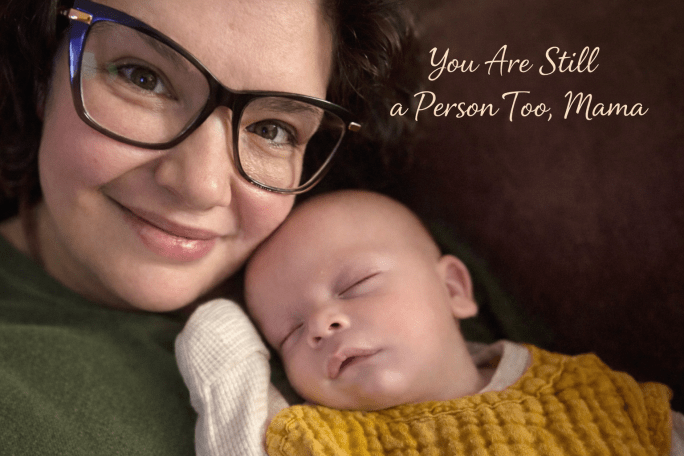
You Are Still a Person, Too

(Why mothers can’t disappear in motherhood)

Somewhere along the way, many mothers quietly disappear.

Not physically — we’re still packing lunches, scheduling appointments, wiping tears, cheering from the sidelines, and showing up for everyone who needs us.

But pieces of us slowly get pushed to the side.

Our hobbies.

Our interests.

Our time.

Sometimes even our identity.

Motherhood is one of the most beautiful callings in the world — but it was never meant to erase the woman God created you to be.

And no matter what season of motherhood you’re in, you are still allowed to exist as a whole person too.

This Post Is for Every Kind of Mom

This post is for the new mom who is still trying to figure everything out.

The one who barely remembers what a full night of sleep feels like and is wondering if she’ll ever feel like herself again.

It’s for the mom learning to juggle siblings, realizing that parenting one child is one thing… but parenting multiple tiny humans with completely different personalities is an entirely new level of chaos.

It’s for the mom of teenagers, who spent years pouring herself into motherhood and suddenly feels a little invisible while her child enters a season that requires less nurturing and… somehow a lot more money. 😂

And it’s also for the mom of adult children, who is learning how to find her place in their lives in a new way. The one trying to balance being supportive without overstepping, learning when to step back, and discovering what it looks like to be both a trusted guide and, eventually, a friend.

Motherhood changes with every season.

But in every season, one truth remains the same:

You still matter, too.

The Myth of the Self-Sacrificing Mom

There’s this unspoken belief that “good moms” give up everything for their children.

Their hobbies.

Their friendships.

Their interests.

Their time alone.

And while motherhood absolutely requires sacrifice, it was never meant to require erasure.

Because the truth is, our children don’t just need caregivers.

They need whole mothers.

Mothers who laugh.

Mothers who rest.

Mothers who still have passions.

Mothers who show them what it looks like to live a full life.

What Special Needs Parenting Can Teach Us

Raising August has taught me a lot about priorities.

There are seasons where our life revolves around therapy schedules, advocacy, and learning new skills. There are days that feel heavy and exhausting.

But there are also moments that remind me that life is still meant to be enjoyed.

Coffee on the porch.

Laughing with my husband.

Watching August jump and crash onto the crash pad like it’s the best game in the world.

And in those moments, I remember that caring for myself isn’t selfish.

It’s necessary.

Because when I take care of my own heart, I show up for my family with more patience, more grace, and more joy.

The Example We Set for Our Children

Our children are always watching.

They’re learning from us what adulthood looks like.

If they only see us exhausted, overwhelmed, and running on empty, what does that teach them about life?

But if they see a mother who takes time to breathe…

who laughs…

who nurtures friendships…

who spends time with God…

who still has pieces of her own life…

They learn something powerful.

They learn that caring for others and caring for yourself can exist at the same time.

Making Room for Yourself

For some moms, making yourself a priority might look big.

For others, it might be small.

Maybe it’s a workout.

Maybe it’s reading a book.

Maybe it’s sitting quietly with coffee before the house wakes up.

Maybe it’s a walk.

Maybe it’s five minutes of prayer and quiet.

It doesn’t have to be glamorous.

It just has to exist.

Because motherhood was never meant to erase the woman God created you to be.

The Truth I’m Learning

I am August’s and Sawyer’s mother.

But that is not the only thing I am.

I’m a wife.

A believer.

A friend.

A woman with dreams, interests, and a life that still matters too.

And the more I learn to care for the person God created me to be, the better mother I become.

Not because I’m doing more.

But because I’m finally learning that loving my children and valuing myself were never meant to compete.

They were always meant to coexist.
Guilt is Not a Parenting Strategy

I used to feel guilty all the time.

Guilty for not doing enough.

Guilty for resting.

Guilty for losing my temper during a stressful episode.

Guilty for needing quiet.

One of the many things this journey has taught me is to let it go.

Call me Elsa.

This season — early mornings, a baby who treats sleep like a suggestion, big emotions and even bigger responsibilities — has made something very clear:

Guilt and shame are not tools.

They don’t make me a better mom.

They don’t regulate my nervous system.

They just make everything heavier.

I’ve learned that conviction and guilt are not the same thing – and one comes from love, not shame.

What I’ve Stopped Feeling Guilty About

1. Asking for Help

Needing help doesn’t mean I’m incapable.

It means I’m raising children in a demanding season. It means I understand that sustainable motherhood isn’t meant to be done alone.

Also, if someone offers to hold the baby so I can shower in peace? I’m saying yes.

Strong moms build support systems.

2. Letting the House Be “Lived In”

My house is not a showroom.

It’s a therapy recovery zone.

A baby play space.

A snack distribution center.

Clean enough is enough.

If you come over and see toys on the floor, congratulations — children live here.

A regulated mom matters more than spotless counters.

3. Napping When the Baby Naps

Rest is not laziness.

Rest helps me show up with patience.

Rest keeps me from turning bedtime into a personality test.

Rest supports my health, my hormones, and even my long-term goals.

I don’t have to earn rest by completing a productivity checklist first.

Sometimes I earn it simply by waking up at 5:00.

4. Saying No

No to overloading our calendar.

No to things that disrupt our rhythm.

No to pretending I have unlimited capacity.

Structure helps.

But rigidity burns us out.

Flexibility > perfection.

If it costs us our peace, it’s too expensive.

5. Protecting Our Peace

Not every invitation is necessary.

Not every opinion deserves space.

Not every comparison deserves attention.

Especially not the ones coming from social media where everyone’s kitchen is spotless and their toddlers eat quinoa without complaint.

I am not competing with influencers who don’t live my life.

We keep it simple here.

Simple meals.

Simple routines.

Simple expectations.

Because simple is sustainable.

The Truth About Mom Guilt

Guilt and shame are not productivity strategies.

They don’t make me more patient.

They don’t make my kids more regulated.

They don’t make this season lighter.

Structure helps.

Flexibility helps.

Rest helps.

Simplicity helps.

But guilt?

I’m not using that anymore.

Grace is a much better teacher.

Navigating Meltdowns

Let’s just say it plainly.

Meltdowns are freakin’ hard.

Not the “wrong color cup” kind. I mean the full-body, nervous-system-overloaded kind.

For a long time, I thought meltdowns meant I was doing something wrong. That if I had prepared better or transitioned smoother or explained more clearly, we could avoid them.

Sometimes prevention helps.

Sometimes it absolutely does not.

And that was a hard lesson for me.

First: You Cannot Reason During a Meltdown

You cannot logic someone out of a nervous system that’s completely overwhelmed.

Trying to reason in the middle of it only makes things worse. It’s not the time for life lessons. It’s not the time for “use your words.” It’s definitely not the time for consequences.

When August is melting down, we don’t lecture.

We make sure he’s safe.

And then we give him space.

August needs space and a soft place to land — literally. We actually have a crash pad in our living room. Just fully committed at this point. If he needs to drop to his knees or crash forward, there’s somewhere safe for him to do it.

When he’s overwhelmed, his body needs release. So we clear the area, stay close enough to observe, and let him work it out.

Close enough to protect.

Far enough not to add more input.

Because nothing says “we’ve adjusted to autism parenting” quite like home decor that doubles as impact protection.

When It Was Really Hard

There was a season when his meltdowns were intense.

He would scratch his arms until they bled.

He would claw at his face.

He would pull at his hair.

It was heartbreaking to watch.

In those moments, space alone wasn’t enough. We had to step in physically to keep him safe. Sometimes that meant giving him a firm “bear hug” — not as punishment, but as protection. Just enough pressure to keep his body from hurting itself.

No one really prepares you for becoming a human weighted blanket, but here we are.

Those were exhausting days.

What Helps August

Over time, we learned that August benefits from proprioceptive input — basically, deep pressure that helps his body regulate.

So we adjusted.

We give him firm squeezes to his large muscle groups.

We press his hands between ours.

We use headphones when he needs pressure around his head.

At school, he sometimes benefits from a compression vest.

These aren’t magic fixes.

But they help.

And sometimes helping a little is enough to shorten the storm.

What I’ve Learned

Meltdowns are NOT manipulation.

They are overwhelm.

They are a tiny nervous system saying, “I cannot handle this right now.”

Our job isn’t to control it.

It’s to create safety within it.

Some days that looks calm and confident.

Some days that looks like me whispering, “Lord, please,” under my breath while barely holding it together in public.

But we’re learning.

We’re adjusting.

We’re finding what works for August.

If you’re walking through intense meltdowns right now — sitting on the floor while your child cries, or driving home in silence after a public one —

You’re not failing.

You’re learning your child’s language.

And that takes time.

August, always.